
QA, SDET, QE - are we asking the right question?
Do we need a QA or an SDET?
Should automation sit alongside development?
Can one role really cover quality, automation, and the bigger delivery picture?
Traditionally:
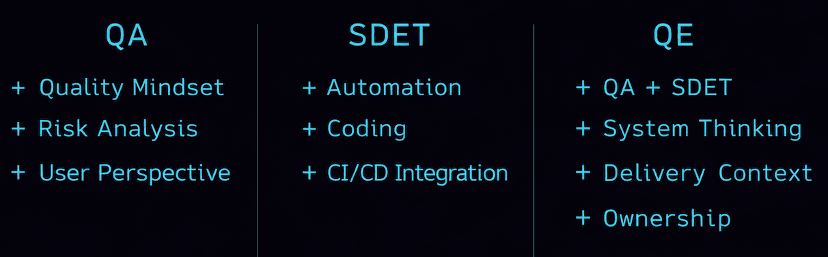
• QA focused on validation, risk, and user impact
• SDET brought strong coding skills and test automation, often closer to development
Automation-first environments, CI/CD pipelines, and complex systems mean that purely manual human-conducted QA is no longer enough.
At the same time, a purely automation-driven SDET can miss broader quality signals, business context, and risk awareness.
💡 This is where we see the evolution toward the Quality Engineer (QE).
𝗔 𝘀𝘁𝗿𝗼𝗻𝗴 𝗤𝗘 𝗰𝗼𝗺𝗯𝗶𝗻𝗲𝘀:
• Core QA principles (quality thinking, risk analysis, user perspective)
• SDET-level technical capability (automation, coding, tooling)
• The ability to see the bigger delivery picture, not just test coverage
It’s not about titles. It’s about clarity, standards, and intent.
At i4ce.uk, we see this challenge repeatedly:
Organisations know quality must evolve, but roles are often defined by assumptions rather than real needs.
That’s why our methodology starts before hiring or placement.
🔹 Understand & Analyse: What does “quality” actually mean for your delivery, today?
🔹 Evaluate & Match: QA, SDET, or QE? We assess against clear people and technical standards, not buzzwords.
🔹 Deliver & Assure: Quality doesn’t stop at placement; we actively assure outcomes throughout the engagement.
This disciplined, end-to-end approach is how we turn evolving Quality standards into real delivery results.
👉 If you’re rethinking QA, SDET, or QE roles, or struggling to define what you truly need, let’s talk.